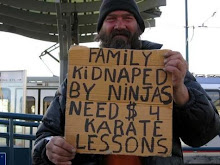
I don't usually do these, but...
And, in keeping with the general blog theme:
Monday, June 22, 2009
Thursday, June 11, 2009
By any other name...
I just learned that one of my more recent favorite authors is, in fact, fictitious. At least, her name and persona are; the actual person exists. Kim Harrison, author of the urban fantasy Hollows series that I follow, recently outed herself as Dawn Cook, a romance/fantasy author. This relationship had been suspected by many, but the question was studiously avoided. In this discussion at Locus (gotta pay for the whole thing, sorry), Cook discusses some of what goes into the creation of the Harrison persona, including a distinctively "dark" wardrobe and wig.
Now, I am by no means decrying the author for their choice to use a different name to promote different works. Established authors do that all the time when they want to move in a different direction. I am saddened a bit in that I liked the Kim Harrison persona. I can see why it was created; lots writers in the urban fantasy genre are offbeat in dress or personality. "Harrison" straddled those conventions rather well; I had put her falling somewhere between the outdated geek-polymath skills of Jim Butcher and the batshit insanity that is Laurell K. Hamilton. It was interesting enough to make me want to know more, without being off-putting. I knew people who were similar in tone and dress. I know people like Hamilton, too, but I don't associate with them. They weird me out, and frankly, that's hard to do.
That said, having learned a while back that Harrison lived relatively close by (in West Virginia Terms, not North Carolina terms;it boils down to "less than a couple of hours away") I had hoped to meet her at a book signing or some such, as Coralius and Aradia recently did. While that still holds some appeal, there's not as much. I have to look at it now with some wistfulness, because the author I liked is now an idea, and not a person. To phrase this vague disappointment in other terms, "There's no 'there' there."
I don't know why a nom de plume should bug me so much. It's a common convention, especially when an author is trying to keep from having preconceptions color work that goes in a different direction. I don't know how often a persona is created around a name, though. That may be it. I want people I'm interested in (even from a distance) to be real. I guess that's what separates a pseudonym from a nom de plume in my mind; the pseudonym is the same person, hiding a real name. A person using a nom de plume like this has a real name; they are a separate person from the idea they have created. That's not to say pseudonymity can't affect personality. I'm far more open and confident behind my 'nym; snarkier, too, per the John Gabriel Theory. However, those are all just factors of who I was to begin with -- I just let them out more publicly when I'm "Ranson". Since I don't know whether or not this may be just as true for the Harrison persona that Cook developed, it really shouldn't affect me.
...
I'm still disappointed just a little, though.
Now, I am by no means decrying the author for their choice to use a different name to promote different works. Established authors do that all the time when they want to move in a different direction. I am saddened a bit in that I liked the Kim Harrison persona. I can see why it was created; lots writers in the urban fantasy genre are offbeat in dress or personality. "Harrison" straddled those conventions rather well; I had put her falling somewhere between the outdated geek-polymath skills of Jim Butcher and the batshit insanity that is Laurell K. Hamilton. It was interesting enough to make me want to know more, without being off-putting. I knew people who were similar in tone and dress. I know people like Hamilton, too, but I don't associate with them. They weird me out, and frankly, that's hard to do.
That said, having learned a while back that Harrison lived relatively close by (in West Virginia Terms, not North Carolina terms;it boils down to "less than a couple of hours away") I had hoped to meet her at a book signing or some such, as Coralius and Aradia recently did. While that still holds some appeal, there's not as much. I have to look at it now with some wistfulness, because the author I liked is now an idea, and not a person. To phrase this vague disappointment in other terms, "There's no 'there' there."
I don't know why a nom de plume should bug me so much. It's a common convention, especially when an author is trying to keep from having preconceptions color work that goes in a different direction. I don't know how often a persona is created around a name, though. That may be it. I want people I'm interested in (even from a distance) to be real. I guess that's what separates a pseudonym from a nom de plume in my mind; the pseudonym is the same person, hiding a real name. A person using a nom de plume like this has a real name; they are a separate person from the idea they have created. That's not to say pseudonymity can't affect personality. I'm far more open and confident behind my 'nym; snarkier, too, per the John Gabriel Theory. However, those are all just factors of who I was to begin with -- I just let them out more publicly when I'm "Ranson". Since I don't know whether or not this may be just as true for the Harrison persona that Cook developed, it really shouldn't affect me.
...
I'm still disappointed just a little, though.
Thursday, June 4, 2009
Option 4
Someone I was following during last year's elections was Sean Tevis. He was a fresh face, and drew a lot of attention with his web-oriented, XKCD-style fund raising campaign. He's not in my jurisdiction by a long margin, but he was interesting and had good ideas.
He lost.
Despite that, he's continued with the new ideas. In particular, he's just going to try and do everything he was asked to, anyway. I like that. He may get some money from me. If there were more politicians of his stripe, I'd have more confidence in the system. As it is, well...
He lost.
Despite that, he's continued with the new ideas. In particular, he's just going to try and do everything he was asked to, anyway. I like that. He may get some money from me. If there were more politicians of his stripe, I'd have more confidence in the system. As it is, well...
Happy Little Trees
I've been having the urge to make something lately. I'm usually not a crafty person (in the sense of creating things, anyway), but every once in a while, I have a need to creatively do something. My problem is, having not been a craft-oriented person for much of my life, I'm not good at very much in that realm. I can muddle along, but I don't have the practice to bring most things from a visualization to reality. I've been successful in the past when directing layout and designs for others; my mind's eye is very aesthetically developed. It's my hands that don't do what I want. I think that's part of the reason I collect gems and jewelry; if I can't create beautiful things, I can at least accumulate and admire them.
Given my limitations, I've found that there are a few creative enterprises that I'm pretty good with. My wife enjoys bead work and jewelry-making, and that's a realm where design and end product translate pretty easily. Even the wire work isn't terribly complicated, though I still need practice, and the design and assembly is something that is fairly easy to work with. A second thing I enjoy is cooking; I love to create with ingredients. I get to practice it fairly often, as well, so I'm pretty proficient. The restraints there tend to be expense, waste, and cleanup. Ingredients cost, people aren't necessarily going to eat what I make, and the cleanup (which I hate) often tempers the enjoyment I get out of a complex and successful dish. As I get to scratch the cooking urge relatively often, it generally doesn't mitigate the urge to make. Occasionally, when I do something unusual or special (I'm planning on doing some rock candy this weekend with my son, assuming he behaves at school), it helps more, but not usually enough.
What I'm most likely to do this time around is make soap. Decorative soap. Yes. Working in the industry I do, the compounding of products has been of great interest to me. My company hasn't done a lot of solids, but I understand the additives fairly well, and understand the process. Small-scale craft soaps are easy. You don't even have to "make" the soap; basic glycerin soap stock is available in a variety of forms and levels of clarity. The crafting comes with the additives, process, and shapes. It takes relatively little time to blend and mold soaps with varying colors, scents, scrubs, emollients, and vitamins, and the end results are beautiful and functional. All these things are factors that I can control to manage an end product that I find attractive. I've got dedicated equipment that's easy to clean, so that's not a big factor. I enjoy it, and don't do it as often as I'd like. Frankly, we've got a lot of my soaps already sitting around; we need to get rid of some, especially if I do more with the new supplies I bought a while back.
I've got to find other things, though, because I'll tire of doing soap if I do it too often. I've got a paper-making kit (a plastic kids kit, but it was $5); that's another process I've loved for a while (I learned to make rag-bond paper from Mr. Wizard back in the day; Don Herbert is missed). That's very messy and takes a lot of practice, though. Recently, I've found myself looking at homebrew kits and what it takes to grow hops. I don't even drink, but that whole process is a combination of my favorite things; it's recipe cooking, it's has an end product that is heavily dependent on the particular additives used, it's got the whole "kid-with-a-chemistry-set" feel, and it's a craft with an end product that I can share with my friends. It's also bloody expensive, and unlikely to happen anytime soon. Still, the itch is there; time will determine if I scratch it.
Given my limitations, I've found that there are a few creative enterprises that I'm pretty good with. My wife enjoys bead work and jewelry-making, and that's a realm where design and end product translate pretty easily. Even the wire work isn't terribly complicated, though I still need practice, and the design and assembly is something that is fairly easy to work with. A second thing I enjoy is cooking; I love to create with ingredients. I get to practice it fairly often, as well, so I'm pretty proficient. The restraints there tend to be expense, waste, and cleanup. Ingredients cost, people aren't necessarily going to eat what I make, and the cleanup (which I hate) often tempers the enjoyment I get out of a complex and successful dish. As I get to scratch the cooking urge relatively often, it generally doesn't mitigate the urge to make. Occasionally, when I do something unusual or special (I'm planning on doing some rock candy this weekend with my son, assuming he behaves at school), it helps more, but not usually enough.
What I'm most likely to do this time around is make soap. Decorative soap. Yes. Working in the industry I do, the compounding of products has been of great interest to me. My company hasn't done a lot of solids, but I understand the additives fairly well, and understand the process. Small-scale craft soaps are easy. You don't even have to "make" the soap; basic glycerin soap stock is available in a variety of forms and levels of clarity. The crafting comes with the additives, process, and shapes. It takes relatively little time to blend and mold soaps with varying colors, scents, scrubs, emollients, and vitamins, and the end results are beautiful and functional. All these things are factors that I can control to manage an end product that I find attractive. I've got dedicated equipment that's easy to clean, so that's not a big factor. I enjoy it, and don't do it as often as I'd like. Frankly, we've got a lot of my soaps already sitting around; we need to get rid of some, especially if I do more with the new supplies I bought a while back.
I've got to find other things, though, because I'll tire of doing soap if I do it too often. I've got a paper-making kit (a plastic kids kit, but it was $5); that's another process I've loved for a while (I learned to make rag-bond paper from Mr. Wizard back in the day; Don Herbert is missed). That's very messy and takes a lot of practice, though. Recently, I've found myself looking at homebrew kits and what it takes to grow hops. I don't even drink, but that whole process is a combination of my favorite things; it's recipe cooking, it's has an end product that is heavily dependent on the particular additives used, it's got the whole "kid-with-a-chemistry-set" feel, and it's a craft with an end product that I can share with my friends. It's also bloody expensive, and unlikely to happen anytime soon. Still, the itch is there; time will determine if I scratch it.
Give it the Chair
I've been following a lot of stories on the death penalty lately, both as a local issue and in general. I'll freely admit to changing my opinion on the matter, just like a lot of my political opinions changed as I grew (both "older and "up"). Given that a recent call from the NRA reminded me that I'm still on a lot of Republican lists, I thought I might revisit some of the stances that cause me to no longer associate with that party.
The death penalty is, at it's heart, a visceral type of justice. It likely originated out of expediency; you can't trust someone who has committed a grievous crime against society to just not do it again. In tribal groups lacking prisons or even enough surplus to sustain a specialized law enforcement population, methods of justice had to be quick and definitive. A lot can be gleaned about a society by examining the circumstances in which it applied the death penalty. It has often been applied to property crimes, particularly involving livestock or other means of sustenance. The use in response to murder is an obvious example, both in primitive and modern societies. The punishment has often been applied to slights of reputation, often in societies where name and status were as important as wealth and possessions in terms of a person's livelihood.
With all those varying applications, the death penalty serves as probably the most definitive punishment available. There's no going back. It is the ultimate vengeance, particularly if, unlike myself, you believe in an afterlife involving punishment. Not only is the punished removed from this life, but they would likely face an eternity of torment on top of it. Of course, the opposite outcome may be true; they may just as well be on their way to a rewarding afterlife. However, I suppose the pragmatic afterlife enthusiast (or atheist such as myself) could rest on the fact that a penalty has been applied the one life we know the convict had.
Again, to point to the gut-level appeal of the death penalty, people are savage beasties. We want those that harm us to hurt. We want our wrongs redressed. Justice is fine, but our reptile brains want some vengeance as a side dish. I understand this, and I think most people do, too. There's a lot of animal structures in our brain and body that list violence as a viable option; the thin veneer of civilization and empathy holds us back.* Jon Stewart of the Daily Show recently covered this in an interview on torture; to want vengeance is to simply be human.
That's where the argument starts to fall apart, though. Vengeance and justice are not the same thing. Vengeance may not fix the problem at hand. Even worse, our legal system is fraught with cases where the wrong person is convicted. To me, that's where the death penalty becomes intolerable. Sure, we have an appeals system; however, what is one to do when potentially exculpatory evidence comes up after appeals are exhausted? There have been multiple cases of death penalty convictions on circumstantial evidence, eyewitness testimony (which is among the least reliable evidence possible), and even coerced confessions. Many of these have been turned over when other evidence came to light (often through the efforts of groups like the Innocence Project), but the fact that such cases even exist are enough to make me rescind and support of the death penalty. Not only is the actual criminal not paying for the crime, but an innocent person will lose their life. As noted above, I think that we only get one of those, so it's fairly important to conserve them where possible [/understatement].
I've seen people continue to defend the death penalty after this argument comes up. I can't grasp that. My question becomes, "What is the exchange rate between innocent and guilty executions?" How many real criminal lives is one good person worth? Is one innocent person per every twenty executions acceptable? One in ten? I've never gotten an answer I consider satisfactory. Not for simple vengeance.
In the end, I just can't support the death penalty anymore. Sure, when I see horrific crimes, I want to claw, gnaw, and kill -- but that's the animal, not the person. The person knows that there's more to it than that.
*One of my favorite books addresses how this applies in societies with highly formal systems of honor and etiquette, such as those found in the middle age Europe and Japan. It consisted of two characters discussing a system of courtesy that one was unfamiliar with. The first said something along the lines of, "Why are you always so polite and formal even with those you dislike?" The reply was, "It doesn't pay to be rude to a man carrying an axe."
The death penalty is, at it's heart, a visceral type of justice. It likely originated out of expediency; you can't trust someone who has committed a grievous crime against society to just not do it again. In tribal groups lacking prisons or even enough surplus to sustain a specialized law enforcement population, methods of justice had to be quick and definitive. A lot can be gleaned about a society by examining the circumstances in which it applied the death penalty. It has often been applied to property crimes, particularly involving livestock or other means of sustenance. The use in response to murder is an obvious example, both in primitive and modern societies. The punishment has often been applied to slights of reputation, often in societies where name and status were as important as wealth and possessions in terms of a person's livelihood.
With all those varying applications, the death penalty serves as probably the most definitive punishment available. There's no going back. It is the ultimate vengeance, particularly if, unlike myself, you believe in an afterlife involving punishment. Not only is the punished removed from this life, but they would likely face an eternity of torment on top of it. Of course, the opposite outcome may be true; they may just as well be on their way to a rewarding afterlife. However, I suppose the pragmatic afterlife enthusiast (or atheist such as myself) could rest on the fact that a penalty has been applied the one life we know the convict had.
Again, to point to the gut-level appeal of the death penalty, people are savage beasties. We want those that harm us to hurt. We want our wrongs redressed. Justice is fine, but our reptile brains want some vengeance as a side dish. I understand this, and I think most people do, too. There's a lot of animal structures in our brain and body that list violence as a viable option; the thin veneer of civilization and empathy holds us back.* Jon Stewart of the Daily Show recently covered this in an interview on torture; to want vengeance is to simply be human.
That's where the argument starts to fall apart, though. Vengeance and justice are not the same thing. Vengeance may not fix the problem at hand. Even worse, our legal system is fraught with cases where the wrong person is convicted. To me, that's where the death penalty becomes intolerable. Sure, we have an appeals system; however, what is one to do when potentially exculpatory evidence comes up after appeals are exhausted? There have been multiple cases of death penalty convictions on circumstantial evidence, eyewitness testimony (which is among the least reliable evidence possible), and even coerced confessions. Many of these have been turned over when other evidence came to light (often through the efforts of groups like the Innocence Project), but the fact that such cases even exist are enough to make me rescind and support of the death penalty. Not only is the actual criminal not paying for the crime, but an innocent person will lose their life. As noted above, I think that we only get one of those, so it's fairly important to conserve them where possible [/understatement].
I've seen people continue to defend the death penalty after this argument comes up. I can't grasp that. My question becomes, "What is the exchange rate between innocent and guilty executions?" How many real criminal lives is one good person worth? Is one innocent person per every twenty executions acceptable? One in ten? I've never gotten an answer I consider satisfactory. Not for simple vengeance.
In the end, I just can't support the death penalty anymore. Sure, when I see horrific crimes, I want to claw, gnaw, and kill -- but that's the animal, not the person. The person knows that there's more to it than that.
*One of my favorite books addresses how this applies in societies with highly formal systems of honor and etiquette, such as those found in the middle age Europe and Japan. It consisted of two characters discussing a system of courtesy that one was unfamiliar with. The first said something along the lines of, "Why are you always so polite and formal even with those you dislike?" The reply was, "It doesn't pay to be rude to a man carrying an axe."
Tuesday, May 26, 2009
An Explanation
Sometimes my friends must wonder about me a little. I've just gotten through a mostly good weekend filled with close friends and family, but there were a couple of chunks where I just didn't participate.
It started with Rock Band, mostly. It's a hell of a lot of fun, and there are enough of us to play and switch out easily, and we're all pretty much competent on any given part. I'll gladly drum and strum for hours...
Except that I don't sing. I'm the only one, and while there's only mild ribbing about it, and lots of encouragement, and the fact that this is likely the most comfortable environment I could have for it, I don't sing. This weekend, another game was brought in, focusing solely on vocals. I didn't participate (and I could have almost certainly been more polite about it, which I regret), and I think they changed things around more quickly than they would've otherwise, to re-include me. I finally did it once, when not everyone was there. I think I owe them an explanation as to why.
Those that know me well know that I have had issues with anxiety (social situations in particular) in the past. I'm talking, break down whimpering, fetal-ball anxiety. I'm over most of that, but I still limit my face-to-face social circle because of it, and I'm even uncomfortable even speaking to them sometimes. I'm much more comfortable with a letter (or a blog post, as the case may be) -- I can think more slowly; correct hastily placed words; nuance my language, etc. As an example, I wrote the first draft of this post the last time we got together, more than a month ago. Like I said, though, I'm mostly better on all that, though I still don't like to pick up the phone. The fact I have close friends at all speaks to it.
How does it all relate, though? Weirdly enough, singing (though not performing or speaking for people in any other way) remains as probably my only really paralyzing anxiety. I still recall first grade, where I was informed after about three seconds of mandatory choir tryout that I had no tone and would be relegated to chorus for the rest of my schooling (at least until choral shows involved optional classes, instead of cramming everyone on stage for the yearly revue). My brother, who was spectacularly devoted and caring in many ways, mocked me for twenty minutes the one time I sang along with the radio in his presence. I've replayed these events and others like them in my head for decades. I occasionally think I have at least a reasonable singing voice, spurred on by the fact I have a decent announcer's voice, if nothing else. I usually stomp that thought into the ground in short order. I don't even sing in the shower -- I mumble, hum, or play songs in my head, all because I'm afraid of hearing my own voice, or, even worse, that someone else might hear my feeble attempts from the other end of the house. I am literally terrified of the thought of singing in front of other people. I have no idea how I managed to do it even the once. I think I was either getting angry at myself, or at everyone else; there is the occasional "put up or shut up" aspect. Given how great I am at expressing myself, it was likely a passive-aggressive way to say "back off and don't ask again", which backfired for two reasons: I didn't do it for everyone, and people might get the idea that if I do it once, I'll do it again. I don't know if that's true, but that's how it feels in retrospect.
I mentioned to someone a while back, that if I had the game and an empty house, I could probably get over the anxiety. It's immediate, objective feedback that has the potential to say, "You don't suck". It would either confirm that I shouldn't be singing, or give me a chance to get over my fears a bit of a time. If I can handle singing out loud, I can handle other people hearing it. Like I said, the only people who would likely ever hear it are my closest friends and family; they're not likely to mock me in a cruel manner (I know them well enough to know that there will be mocking, regardless. We'd mock a professional; it's what we do). One even asked if she'd ever get to hear me; I believe that she genuinely wants to hear me, would never be critical, and just wants me to enjoy myself. I want that as much as anyone.
I could probably get to the point where I'm comfortable singing with them. I can't get there with them around, though. I have this thing where I have to improve things alone. Every instrument I've ever practiced has been behind closed doors (didn't do a lot of good with drums, but it's hard for non-drummers to tell if you're skilled if it's the only sound going on). I exercise alone. Ironically, if I want to convince myself I'm good enough for my friends, I have avoid them. It sucks, but that's where I am. I've torn away most of the crippling fears that used to wrap around me. This one's still sticking, and I want to work on it. In an empty house with the shades drawn, but, still, I want to. They probably won't hear me until I do.
It started with Rock Band, mostly. It's a hell of a lot of fun, and there are enough of us to play and switch out easily, and we're all pretty much competent on any given part. I'll gladly drum and strum for hours...
Except that I don't sing. I'm the only one, and while there's only mild ribbing about it, and lots of encouragement, and the fact that this is likely the most comfortable environment I could have for it, I don't sing. This weekend, another game was brought in, focusing solely on vocals. I didn't participate (and I could have almost certainly been more polite about it, which I regret), and I think they changed things around more quickly than they would've otherwise, to re-include me. I finally did it once, when not everyone was there. I think I owe them an explanation as to why.
Those that know me well know that I have had issues with anxiety (social situations in particular) in the past. I'm talking, break down whimpering, fetal-ball anxiety. I'm over most of that, but I still limit my face-to-face social circle because of it, and I'm even uncomfortable even speaking to them sometimes. I'm much more comfortable with a letter (or a blog post, as the case may be) -- I can think more slowly; correct hastily placed words; nuance my language, etc. As an example, I wrote the first draft of this post the last time we got together, more than a month ago. Like I said, though, I'm mostly better on all that, though I still don't like to pick up the phone. The fact I have close friends at all speaks to it.
How does it all relate, though? Weirdly enough, singing (though not performing or speaking for people in any other way) remains as probably my only really paralyzing anxiety. I still recall first grade, where I was informed after about three seconds of mandatory choir tryout that I had no tone and would be relegated to chorus for the rest of my schooling (at least until choral shows involved optional classes, instead of cramming everyone on stage for the yearly revue). My brother, who was spectacularly devoted and caring in many ways, mocked me for twenty minutes the one time I sang along with the radio in his presence. I've replayed these events and others like them in my head for decades. I occasionally think I have at least a reasonable singing voice, spurred on by the fact I have a decent announcer's voice, if nothing else. I usually stomp that thought into the ground in short order. I don't even sing in the shower -- I mumble, hum, or play songs in my head, all because I'm afraid of hearing my own voice, or, even worse, that someone else might hear my feeble attempts from the other end of the house. I am literally terrified of the thought of singing in front of other people. I have no idea how I managed to do it even the once. I think I was either getting angry at myself, or at everyone else; there is the occasional "put up or shut up" aspect. Given how great I am at expressing myself, it was likely a passive-aggressive way to say "back off and don't ask again", which backfired for two reasons: I didn't do it for everyone, and people might get the idea that if I do it once, I'll do it again. I don't know if that's true, but that's how it feels in retrospect.
I mentioned to someone a while back, that if I had the game and an empty house, I could probably get over the anxiety. It's immediate, objective feedback that has the potential to say, "You don't suck". It would either confirm that I shouldn't be singing, or give me a chance to get over my fears a bit of a time. If I can handle singing out loud, I can handle other people hearing it. Like I said, the only people who would likely ever hear it are my closest friends and family; they're not likely to mock me in a cruel manner (I know them well enough to know that there will be mocking, regardless. We'd mock a professional; it's what we do). One even asked if she'd ever get to hear me; I believe that she genuinely wants to hear me, would never be critical, and just wants me to enjoy myself. I want that as much as anyone.
I could probably get to the point where I'm comfortable singing with them. I can't get there with them around, though. I have this thing where I have to improve things alone. Every instrument I've ever practiced has been behind closed doors (didn't do a lot of good with drums, but it's hard for non-drummers to tell if you're skilled if it's the only sound going on). I exercise alone. Ironically, if I want to convince myself I'm good enough for my friends, I have avoid them. It sucks, but that's where I am. I've torn away most of the crippling fears that used to wrap around me. This one's still sticking, and I want to work on it. In an empty house with the shades drawn, but, still, I want to. They probably won't hear me until I do.
Friday, May 1, 2009
My son, the confidence man
I should've expected it sooner; he is my kid, after all.
So it turns out that my son has been scamming breakfasts at school. We had been mystified at the charge bills, the "free lunch" applications and calls from the school saying he was on "alternative meals" until we paid up. He eats at home, and has a lunch packed every day. However, these charges kept piling up. Finally, my wife gets in contact with the head lunch lady for an explanation.
The boy has been eating a second breakfast at school everyday, in addition to his home breakfast (No word on "elevensies", though). In addition, he's supposed to be on "alternative" meals, since he maxed out his account limit -- alternative breakfast is milk and a pack of graham crackers. Despite this, he's been getting milk, juice, and cereal every day. How you ask? Pure cute mixed with pitifulness, that's how. He just doesn't have the money (which is true, since we don't give him any). This has been sorted out rather quickly, now that we know what's going on, but the kid's a good manipulator.
Now, why should I have expected this, just because he's my spawn? Because I did almost exactly the same thing. My school lunches at that age cost $0.50, with a quarter for milk. After the main meal, you could buy ice cream for an extra quarter. With this setup, my parents provided me with a dollar a day. Being the greedy little sonofabitch I was, I decided that a daily quarter was more valuable than a daily ice cream (this thought process led me to accumulate over $100 over a couple of years, which was not insubstantial given my age and the decade involved). Over time, my teachers noticed that while I looked longingly at the ice cream, I never purchased any. Given that I lived in a little craphole of a trailerpark within sight of the school, they assumed I just didn't have the money, and started slipping me ice cream. They never actually asked me if I had the money or not, and my little 5-year-old mind went "SCORE"! The situation lasted until the first parent-teacher conference, and I didn't get in trouble, since I hadn't really lied to anyone to acquire the ice cream. Still, that experience was pretty typical, and my son seems to be following in my footsteps.
Now we just have to wait until he manages to get engaged with a team sport, and see if he gets involved in a gambling scandal, like I did with soccer in 3rd grade.
So it turns out that my son has been scamming breakfasts at school. We had been mystified at the charge bills, the "free lunch" applications and calls from the school saying he was on "alternative meals" until we paid up. He eats at home, and has a lunch packed every day. However, these charges kept piling up. Finally, my wife gets in contact with the head lunch lady for an explanation.
The boy has been eating a second breakfast at school everyday, in addition to his home breakfast (No word on "elevensies", though). In addition, he's supposed to be on "alternative" meals, since he maxed out his account limit -- alternative breakfast is milk and a pack of graham crackers. Despite this, he's been getting milk, juice, and cereal every day. How you ask? Pure cute mixed with pitifulness, that's how. He just doesn't have the money (which is true, since we don't give him any). This has been sorted out rather quickly, now that we know what's going on, but the kid's a good manipulator.
Now, why should I have expected this, just because he's my spawn? Because I did almost exactly the same thing. My school lunches at that age cost $0.50, with a quarter for milk. After the main meal, you could buy ice cream for an extra quarter. With this setup, my parents provided me with a dollar a day. Being the greedy little sonofabitch I was, I decided that a daily quarter was more valuable than a daily ice cream (this thought process led me to accumulate over $100 over a couple of years, which was not insubstantial given my age and the decade involved). Over time, my teachers noticed that while I looked longingly at the ice cream, I never purchased any. Given that I lived in a little craphole of a trailerpark within sight of the school, they assumed I just didn't have the money, and started slipping me ice cream. They never actually asked me if I had the money or not, and my little 5-year-old mind went "SCORE"! The situation lasted until the first parent-teacher conference, and I didn't get in trouble, since I hadn't really lied to anyone to acquire the ice cream. Still, that experience was pretty typical, and my son seems to be following in my footsteps.
Now we just have to wait until he manages to get engaged with a team sport, and see if he gets involved in a gambling scandal, like I did with soccer in 3rd grade.
Subscribe to:
Posts (Atom)